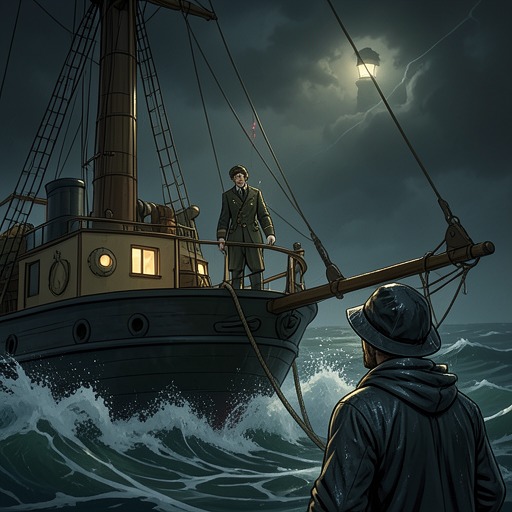
Queeg conceals and misrepresents the grounding
The Caine Mutiny Court-MartialQueeg conceals and misrepresents the grounding is the episode in which a minor grounding becomes a consequential test of Captain Queeg’s accountability and command. After the USS Caine is pulled free of the mud in West Loch, Queeg decides not to send an immediate report. When ComServPac later demands an explanation, he prepares an official account that blames the engine room’s response and casts the failure to report as a defensible judgment. Willie Keith, ordered to deliver the document, reads it on the way. The contrast between what the crew witnessed, what Queeg chose not to report, and what his report says gives the incident its force.
The grounding and the decision not to report
The Caine runs slightly aground on a mudbank in West Loch. The ship is not damaged, and a tug pulls it off. Burt Gorton raises the obvious next step: a grounding report to ServPac. Queeg does not authorize it. Instead, he points to a tug nearby and has it called over. Once the towline is rigged, the vessel is pulled free without difficulty. Queeg thanks the tug captain, then treats the matter as finished and directs the ship toward the fueling dock.
His response is not simply to leave the paperwork for later. He tells Gorton that there is no sense stirring ComServPac up over what he considers nothing. This choice turns the omission into part of the episode itself: the question is no longer only why the ship grounded, but why its captain decides that higher authority need not be informed at once. Queeg’s confidence gives the decision an air of routine, even as it places him in control of whether the incident enters the official record.
The ship’s subsequent approach to the fueling dock sharpens the contrast between the apparently trivial mishap and the command judgment surrounding it. Queeg brings the Caine toward the dock at fifteen knots on a steep angle, creating alarm among Gorton, Steve Maryk, and Willie Keith, then backs down at the last moment and berths the ship neatly. The maneuver succeeds, as the grounding has ended without damage. But success in the immediate outcome does not resolve the question of reporting; Queeg’s assurance that the matter is over will soon meet an order from ComServPac.
ComServPac demands an account
The demand arrives as an action dispatch over the harbor circuit. Willie decodes it: ComServPac wants a written explanation for the morning’s grounding in West Loch and for the failure to report it by dispatch. The request makes explicit that the omission, not merely the grounding, requires an answer. Willie would rather not take the message to Queeg, but he does so because there is no way around his duty.
Queeg is in his room, in his underwear, working through official mail when Willie brings him the dispatch. He reads it, sits upright, and studies the sheet while Willie searches for an excuse to leave. Queeg’s first response is to speculate about how ComServPac learned of the grounding. He concludes that the tug’s chief boatswain must have reported it after returning to shore, then admits that he might have thought of that possibility himself. The exchange reveals the difference between Queeg’s private assumption—that a minor incident could be handled without troubling higher authority—and the service’s expectation that the incident be reported.
Queeg responds by ordering Willie to spruce up and stand by to deliver the report by hand. That instruction places Willie in a narrow but significant position: he is not asked to decide what the report should say, yet he is entrusted with carrying it and can see its contents. An hour later, on the yard bus to the ComServPac building, he gives in to curiosity. The manila envelope is held shut only by a flexible metal clasp; after glancing around to see whether anyone is watching, he slides the report out and reads it on his lap. The document becomes available to the reader through the same subordinate who must deliver it.
The official account
The report dates the grounding to September 25, 1943, at 9:32 a.m. It states that the Caine ran slightly aground on a mudbank and was floated off by YT 137 at 10:05. It records no casualties or damage. These details present the mishap as limited in physical consequence, but they also make the document’s explanation and its handling of the delayed dispatch especially important.
In the report’s account of cause, the engine room failed to respond in time to engine orders sent from the bridge. That is the official explanation Queeg signs, not an independently established finding in the episode. The document also says that the command had recently been relieved and that the crew’s training warranted a drastic drilling program, which had already been instituted. It links the grounding to deficient performance aboard the ship and presents Queeg’s new drilling regime as the corrective measure.
The report gives a separate explanation for why no dispatch was sent at the time. It says that a full report was intended for delivery by messenger the following morning; assistance was available, damage was nil, and the matter appeared manageable without unnecessarily troubling higher authority. It expresses regret if that estimate was wrong. The language transforms Queeg’s earlier decision into a reasoned estimate, while the dispatch from ComServPac makes clear that the command expected an immediate report. The report closes by predicting that intensive drilling will quickly produce competent performance and prevent a recurrence, and it bears the signature Philip Francis Queeg. The signature makes the account not merely a draft explanation but Queeg’s formal version of the event.
Exposure and significance
The episode sets the report against the circumstances of its delivery. Queeg had first treated the grounding as negligible and declined an immediate dispatch; the later document explains that decision as a judgment about avoiding unnecessary trouble. ComServPac’s demand, apparently prompted by information from the tug, removes Queeg’s control over whether the incident is known and requires him to account for both the grounding and the omission. The report then shifts attention toward the engine room and the crew’s training, even as it presents Queeg’s own decision not to report as reasonable.
Willie’s reading also lands against his recent favorable view of the new captain. In a letter to May Wynn, he had described Queeg as a strict perfectionist and hard taskmaster, but also as a pleasant, daring seaman who seemed to be exactly what the Caine needed. The report does not instantly erase that impression, but it supplies a concrete contradiction for Willie to encounter: the captain he has praised has chosen what to disclose and how to assign responsibility. The reader, like Willie, sees the official account before seeing any resolution to the challenge it raises.
The wider shipboard culture gives the episode additional resonance. Tom Keefer tells Maryk that the Navy’s book is necessary during wartime, even while arguing that rigid rules and the Caine’s abnormal condition make the ship difficult to run by the book. That tension—between procedure as an obligation and procedure as something a commander can interpret—reappears in Queeg’s handling of the report. His authority allows him to frame the omission as sound judgment, but the arrival of the dispatch shows that the institution has its own expectations. Later, Maryk’s visible disbelief when Queeg imposes a collective leave penalty, and his objection to the punishment, further show how the captain’s decisions place subordinate officers between obedience and speaking up. The grounding report is an early, sharply bounded instance of that pressure: the incident is physically over, but its official meaning remains under Queeg’s control until the demand for an account forces it into view.